
The meaning of a CTO is often misunderstood, particularly in mid market organisations where technology leadership must balance strategy, operations and innovation.
While the title Chief Technology Officer is widely recognised, the responsibilities behind it can vary depending on how central technology is to business growth and performance.‘
There is no widely accepted definition of the role. However, in our view, a CTO is a Board-level executive responsible for all the technology in the company — including, but not limited to, its IT. Understanding the meaning of a CTO helps leadership teams clarify how technology strategy supports long term commercial objectives.
The term ‘CTO’ best describes the role required when technology is a significant part of a company’s revenue, profit, or value, often through online and digital initiatives.
A good CTO will have a deep understanding of technology, particularly custom software development, combined with real-world commercial experience. A good CTO also understands funding, valuation, and exit.
A CTO can transform a business by fostering innovation, efficiency, and streamlining. When a CTO combines technology expertise with real-life business experience, they can have a significant effect on the valuation of a company.
What are the roles and responsibilities of a CTO?
A CTO is responsible for all the technology in the company, as well as all the teams and suppliers relating to technology. The CTO manages all the relevant budgets and ensures the secure, reliable, and efficient operation of all these resources. This is often where the practical meaning of a CTO becomes clear across systems, suppliers and internal technology teams.
More importantly, the CTO uses systems and digital to drive innovation and deliver value. This may mean streamlining and automation, or more specific changes, such as improvements to customer service. These changes will often involve creating custom software for market-facing systems.
The software may be central to the business plan, and the CTO may have a key role in communicating the plan to investors and other stakeholders. Thus the CTO’s credibility and track record will be important to the credibility of the plans, and, as a result, the credibility of the entire company.
Are there different types of CTO?
There can be many variations in the roles and responsibilities of a CTO, depending upon the needs of the business. Some CTOs will focus more on infrastructure; others may spend more time on the technology itself. These days, when so much business is conducted online, a CTO may spend the majority of his or her time on customer acquisition or the customer experience.
Often a CTO will take a more global view of the business, looking for ways technology can drive value. This may involve implementing a new ERP or streamlining the IT to increase efficiency and lower overhead.
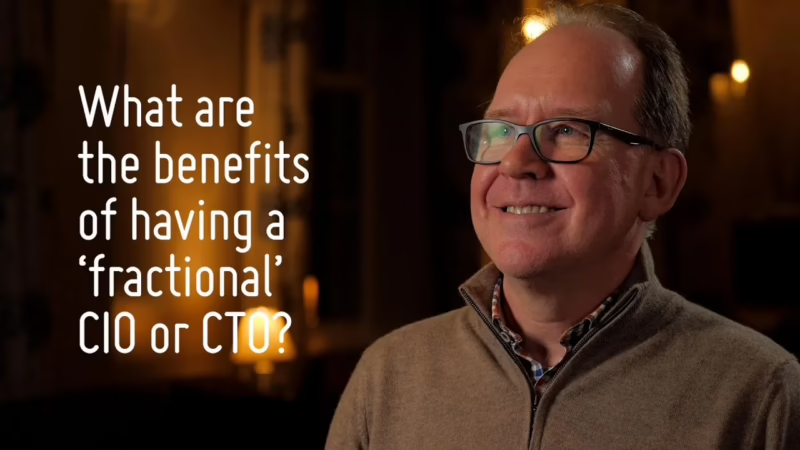
The exact responsibilities of the CTO will always be driven by the needs of the business, especially for mid-market companies. In these cases, a ‘fractional,’ or part-time CTO, is an affordable alternative.
How a CTO impacts businesses of different sizes
A CTO will have a profound effect on a business of any size. The CTO of a multinational corporation may have thousands of subordinates, and the ability to inspire other leaders, to seek out opportunities and negotiate with internal and external partners will make an enormous difference to the bottom line. Their approach to innovation and security will strongly influence the corporate culture.
In a small business, particularly in startups, the CTO is crucial to survival. They must be nimble and flexible, wearing whatever hat is necessary to keep the business functioning. Since so many startups deal with technology products, the CTO’s talent and acumen is absolutely vital.
In the mid-market space, CTOs combine nimbleness and vision. Here the CTO should influence the culture, such as fostering good security habits and deal directly with suppliers. And they also must be thinking ahead, aligning technology needs to business goals so that the business will thrive.
‘Investing in IT has been – and will continue to be – critical for the continued growth and success of our business. Freeman Clarke has given us the confidence we need to make those investments. The flexibility and depth of experience provided by the Freeman Clarke model has been ideal for us as we’ve grown.’
–Peter Davies, COO, Gateley
Why Freeman Clarke?
Freeman Clarke CTOs work on a ‘fractional,’ or part-time model. This provides a business with first-class technology leadership without the full-time cost.
Our fractional CTOs are uniquely suited to mid-market businesses. They have outstanding technical expertise. They are strategic thinkers. They understand how to use technology to drive growth. But they are also suited to the culture and reality of mid-market business.
Understanding the meaning of a CTO helps leadership teams decide whether their organisation needs stronger technology direction at Board level. For many mid market businesses, a fractional CTO provides strategic leadership aligned with business objectives without the cost of a full time executive.